Aaron Mikail
Miss Kim
CP English 10A (1)
2 October 2009
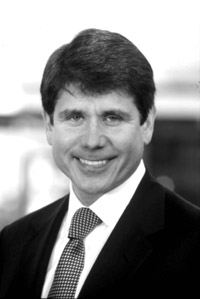
The speaker, Rod Blagojevich, attempts to prove his own innocence with this speech full of persuasive statements, rhetoric, and repetition given to the people and other political figures. Rod Blagojevich, an American politician who served as the governor of Illinois for a seven year period, during 2003 through 2009, was charged for corruption. Consequently, Blagojevich was removed from office and impeached by the Illinois General Assembly after a prolonged investigation and case, in which he recited a speech. It has been stated that Blagojevich abused his own power and attempted to bribe his seat in the senate during the election of Barack Obama. His statements in which he struggles to persuade the people lacked relevant information, other than the necessary vital information.
Blagojevich struggles to find every possible excuse or justification in order to obtain sympathy from the audience, and uses rhetoric such as red herring to support his needs. Blagojevich laments, “And it’s not about me as much as it is about not shaming my daughters, so that their dad, they might think may have done some things he didn’t do, and allowing them to have this feeling that I let them down, and even more important than my daughters, the people of Illinois” (Blagojevich 3). In this scenario, Blagojevich’s intention was to step away from the major issue by stating completely irrelevant information to remove the topic from the audience’s minds. He persistently neglects his own actions in this speech. Furthermore, this topic of his children arises, who are innocent figures of daily society in which many parents and the people overall could relate to. By including his children and how they may perhaps begin to resent their own father, people sympathize for them. Additionally, he puts the audience in his own position by stating, “Imagine how you’d feel…” (Blagojevich 1), and also states that the same struggle he has faced may also cause inconvenience to you as well, in which you have absolutely no way to escape this trouble. This puts pressure on the people, creates a fearful and an uncomfortable feeling, and leaves them in this poor position he is in. Another quote including pathos, “It is painful to be in a car and drive to see people sitting, standing at bus stops or walking down the street who voted for you… and they’ve hired you and trusted you…” (Blagojevich 3). In this quote, he states he is one who feels pity for the average person, and feels guilty for putting these people in such a position since they had voted for him and put him in the high position he is in today.
I believe Blagojevich displayed innovative ethos, though simultaneously absurd and completely apparent to me, as a reader. One technique in which he presented ethos was using repetition putting emphasis, which he intends to stress his own innocence. He later requests for another chance and would reveal all evidence to prove the people wrong. Using repetition, Blagojevich implores, “But I want you to know—I want you to know—I never, ever intended to commit a criminal act, I never—in any conversation—intended to violate any criminal law” (Blagojevich 4). Additionally, because the media frequently brings issues into extreme exaggeration and falsifies, putting pressure on celebrities, Blagojevich perhaps feels that it would be beneficial to put blame on them. He decides to blame the media and American society for lying about the issue, and states that his own actions committed were neither illegal nor unjust. Also, Blagojevich uses prestige identification and prodded, “This is not Richard Nixon and Watergate trying to keep the tapes from being heard” (Blagojevich 4). By using these two political figures, Blagojevich tries to lower the intensity of the issue and his own faults. Blagojevich also struggles to prove that he is a trustworthy person and is always responsible for his own actions by stating, “Now if I felt I did something wrong, I would have resigned in December. If I felt I had violated a law, I would meet my responsibilities, I would have resigned in December” (Blagojevich 1). In this quote, he stresses that if he had in fact committed such acts, he would have done various actions of truth and modesty for the people. Lastly, Blagojevich mentions the liberties, freedoms, and benefits he has created for the people of Illinois, enumerating, “…think about the things we’ve been able to do together: Health care for all of our kids, first in the nation…Holding the line on taxes. Think about all the good things we’ve been able to do for people. Give me a chance to stay here so we can roll up our sleeves and continue to do good things for people (Blagojevich 4). To the people, this quote could reveal that Blagojevich is a man of success and one who has accomplished abundances for them. In conclusion, the total amount of persuasive statements in his demonstration of pathos and logos, and his continual confident tone give the reader second thoughts, revealing a more innocent and responsible person. His words illustrate a more successful individual, and one who could relate to the average person after stating his accomplishments. However, Blagojevich presented many faults; including neglecting his own actions and stating they were neither illegal nor unjust. Furthermore, he fails to apologize to the audience about his dire actions. Contrasting the people’s credibility, I do not believe Blagojevich for the reason that I am familiar with the various persuasive methods, and singularly think he took advantage of the people.